Our method · Open standard, spec v1.1

The Agentic Development Protocol

The method behind everything we build and teach. An open standard for building software with AI agents that you can verify, not just trust.

~80 deploy rounds · 226 archived tasks · 159 process misses turned into rules

Open licence: documentation CC BY 4.0, code MIT. Derived from a real production system.

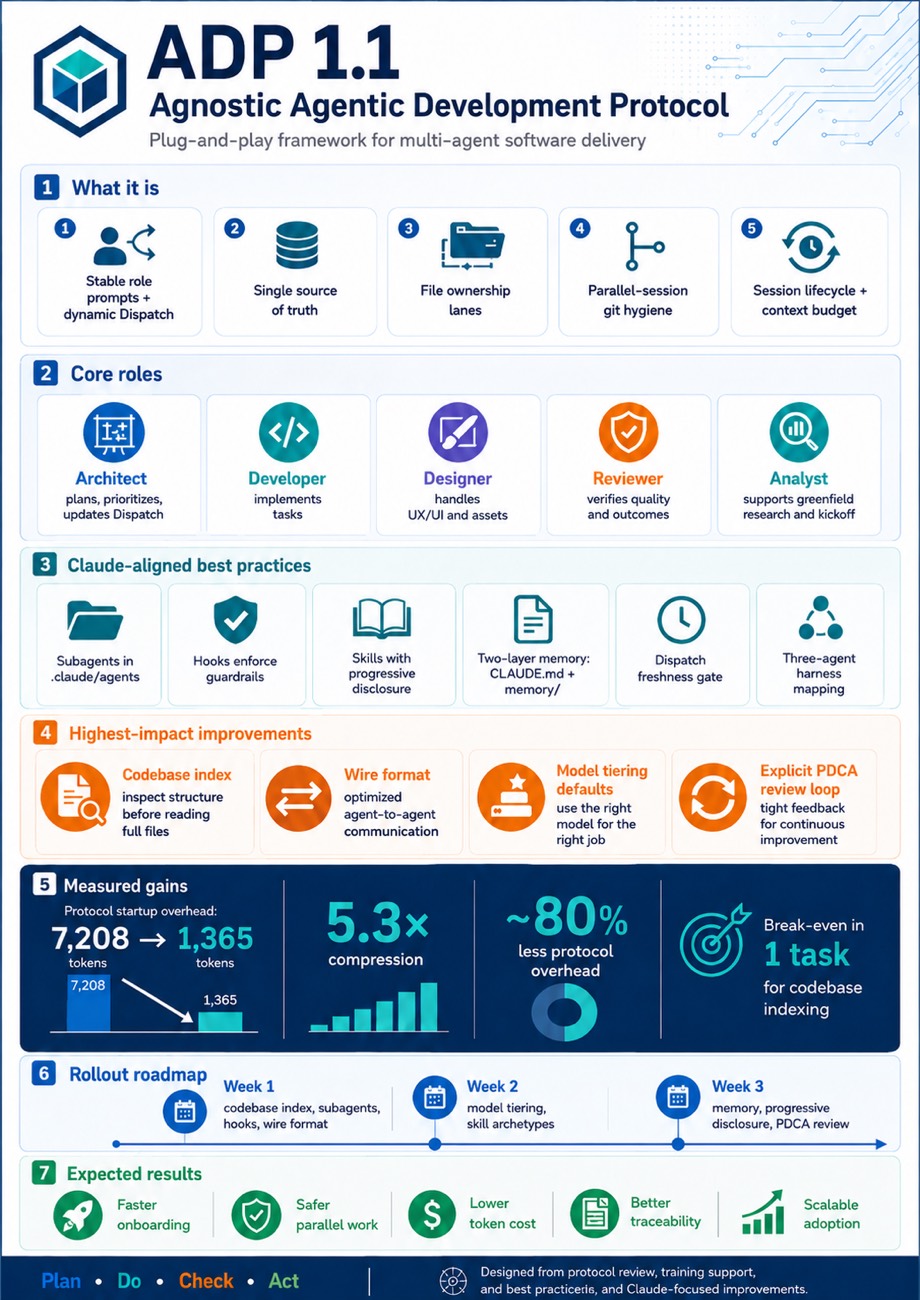
Overview diagram of the Agentic Development Protocol 1.1

Why it exists: teams struggling with AI rarely have worse models. They run the same old process with faster typists. Parallel AI sessions collide, context gets lost, and nobody can prove the system still works tomorrow. ADP is the process layer that closes that gap.

Five patterns, one standard

The core of the spec. Each pattern came from a real failure in production.

Stable roles, dynamic dispatch

Fixed agent roles with a clear contract. Work is assigned to them as it comes.

Plan, do, check, act, with evidence

Every claim carries a receipt. The check accepts it or it doesn't.

The process-miss ledger

Every miss becomes a rule that the next round is held to.

Token economics

Cost is measured in tokens, not man-days, and tied to shipped, verified changes.

Build to rebuild

Docs and tests are the asset. If you can regenerate a module from them, you own the system.

For a small business, this becomes a simple five-step cycle: identify, plan, do, check, improve. See how we apply it.

The evidence, including what we got wrong

Measured on the AVApmo production system and a public LLM benchmark. Falsified claims are published next to the ones that held.

3,618
non-merge commits, one human with an agent team, 6.5 months
249
claims that held (lower bound)
43
claims we falsified
42
runs of an LLM benchmark, 7 models (2 more on a harder level)
109
adversarial agent-tester runs

Figures re-measured in v1.1.6 (August 2026). Earlier published numbers were corrected, and the corrections are public. Current tooling: v1.1.7 (October 2026) — the hooks now say so when they cannot enforce, the size limits on the shared task file became a script, and commits name their files explicitly. The spec stays 1.1. Read the changelog.

Senior engagements for engineering teams

The protocol is free. The judgment is what you hire.

Fixed-scope engagements for teams already building with AI: calibration, baselines and accountability.

AI and agentic diagnostic

fixed scope · 2 days

Your AI-coding workflow mapped against failure modes already seen in production, including whether your team could rebuild a module from its docs and tests. A written diagnostic and a clear go or no-go.

Quoted after a first call

Book a diagnostic
Build and install

fixed scope · build engagement

Governed agentic AI systems, from multi-agent orchestration to scoped RAG and threat modelling, plus the ADP process layer. Your team is trained to run it alone.

Quoted after a first call

Scope a build

Fractional lead AI architect

monthly

Weekly direction across your AI initiatives, evidence-based review of closed work, and the method embedded in how your team works.

Quoted after a first call

Talk to us
Roadmap

From one team to many

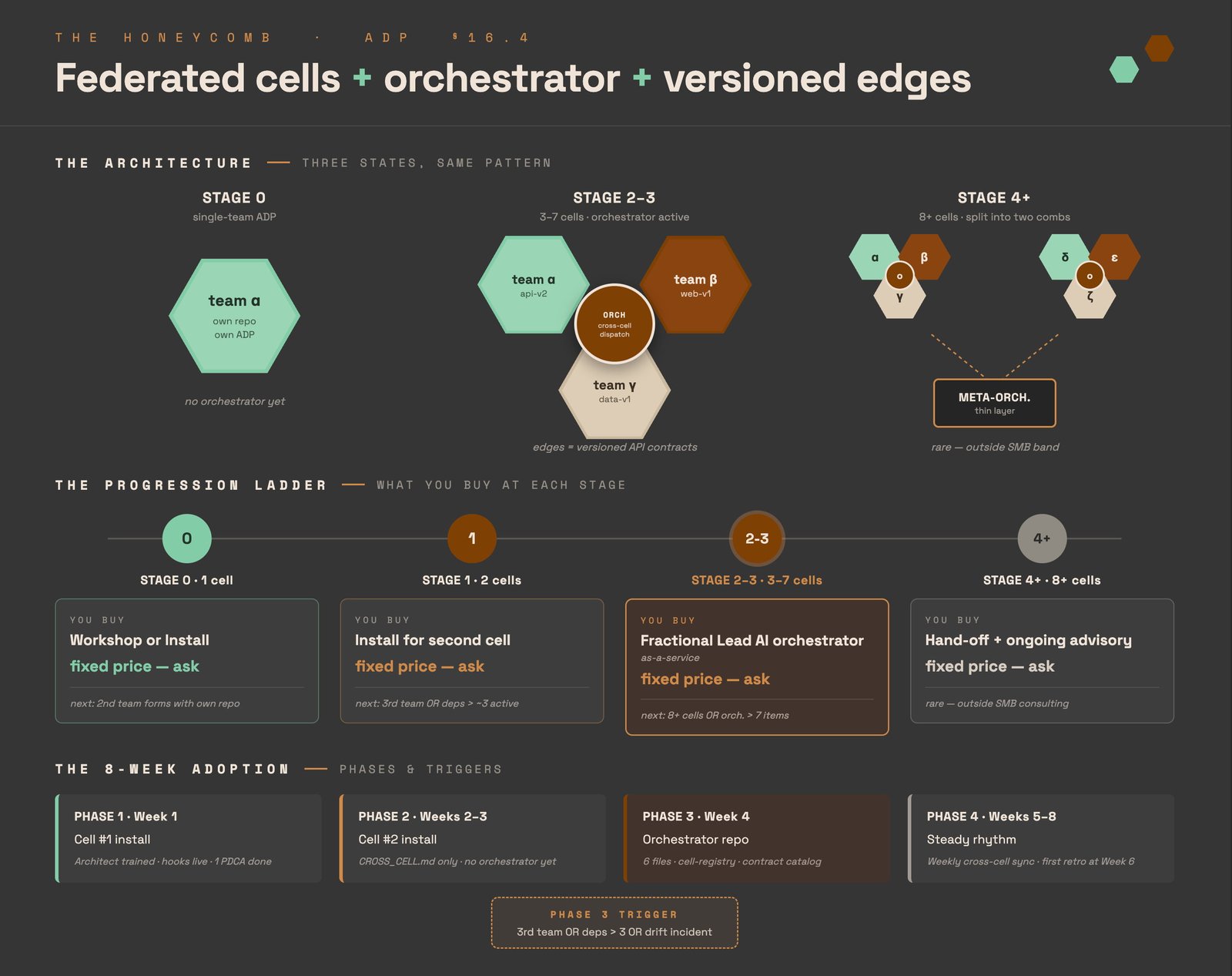
The same protocol scales to several teams working as connected cells, with an orchestrator and versioned agreements between them. This is the published design for multi-team adoption. It is not yet proven in production, and we say so.

Diagram of several ADP team cells connected through an orchestrator
Cover of the ADP executive briefing

Executive briefing

Why ADP, the evidence, and the shift in method, in 12 pages. For CTOs, heads of engineering and senior project managers.

You'll also receive protocol updates. Unsubscribe anytime. Privacy

Protocol updates

New versions, benchmark results and audit findings as they ship. Nothing else.

Unsubscribe anytime. Privacy

Questions

Can't we do this internally?

Yes, if a senior engineer has a few free months. The protocol is open. What an engagement adds is the experience of the failures it was built from, baselines to know whether it works, and an outside reviewer.

Doesn't Claude or Copilot already do this?

Those are tools. ADP is the method around them: who does what, how work is checked, how cost is measured. The tools plug into it.

What's the catch with "free"?

None. The spec is open and meant to spread. Paid work is the diagnostic, the baselines and the review, never the document.

How proven is it?

The sample is small: one production system and one public benchmark. The protocol grades its own claims and publishes what it got wrong. Read the changelog and the history before you rely on it.

Guillermo Blanco

Who's behind it

Guillermo Blanco: 25 years leading programs in banking, insurance and SaaS, in Europe and Latin America. PMP since 2007, Google Cloud Generative AI Leader certified. ADP is the method extracted from running an AI agent team in production, mistakes included.

LinkedIn ↗